
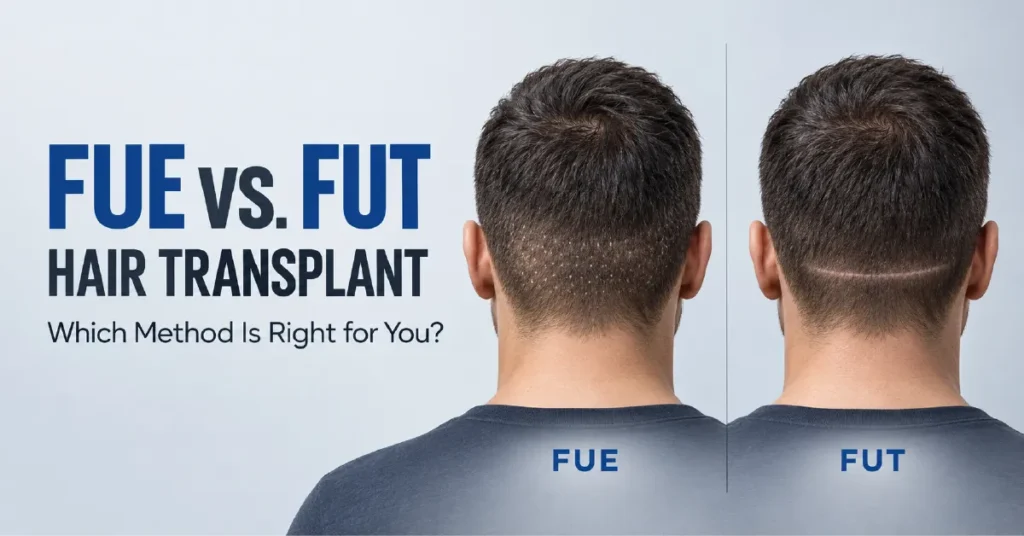
Opting between different hair transplantation techniques can be overwhelming, as each term related to the procedures might look complicated. You might already be aware that both FUT and FUE hair transplants are proven methods to tackle hair loss effectively, but they cannot be interchanged, as each is unique and the procedure is different[1]. For those of you who are looking for a hair transplantation method with a short recovery and love wearing short hairstyles, FUE would be a suitable choice. Some people might need a higher number of grafts to be implanted in a single session to cover a large balding area, and those who have a tight budget can opt for the FUT procedure to get exceptional outcomes at a lower cost. Choosing between FUE vs. FUT hair transplant is based on factors like scalp anatomy, hair goals, time you can spend on recovery, and lifestyle.
Hair Loss: Why Hair Transplant is a Suitable Choice?
Hair loss has become a common issue that affects about 50% of females and 85% of males irrespective of their age. It might develop as a slow process, slowly receding your hairline, or as an aggressive process creating thinning or balding on the crown, causing significant psychological impact. Your hair can influence your self-image, confidence, and even specific perceptions related to career, especially if you are a celebrity.
Learn more about hair transplantation at Kolors, including the procedure, treatment benefits and factors that influence individual results.
A hair transplant procedure is a safe and effective solution to hair fall and is more effective than any topical treatment, hair care product, or supplement[2]. By transferring healthy follicular units from the donor zones at the sides and back to balding and thinning sites, a hair transplant procedure will help restore the lost hair density that will last until your lifetime[3]. To make the right decision, it is essential to evaluate the differences between FUE vs. FUT hair transplant to figure out which one would align with your hair goals.
What is Follicular Unit Transplantation?
When comparing FUE vs. FUT hair transplant, learning about how each technique is performed will give a clear insight into which one to choose. This strip transplantation method is highly popular for its effectiveness and ability to deliver a higher graft yield per session due to its accurate and high-precision implantation process[4]. Using a scalpel, a small strip from the scalp will be removed by the surgeon, and it will be dissected further under a microscope to collect healthy follicles. Each follicular unit will have four to one hair, which might vary from one individual to another.
The donor site from where the strip was removed will be closed using sutures or the stapling method. After closure, the transplant will leave a linear scar permanently at the backside of your head. You can hide it by wearing a long hairstyle with hair falling over the scar. You must rest with a lot of restrictions, and the recovery period will be longer until the strip sutures completely heal and follicles begin to grow new hairs. This strip method, or Follicular Unit Transplantation, has become popular since its inception during the 1990s and is an invasive method as it involves surgical removal of a strip of the scalp.
Major benefits of opting for the Follicular Unit Transplantation method are:
- The procedure is a perfect choice to achieve 5000-plus graft harvest in one session.
- When compared to FUE hair transplant, the cost of FUT is lower per graft.
- The incidence of accidental hair follicle damage is lower while harvesting, as the strip of scalp is dissected under a controlled environment.
- Though FUT will cause a linear scar, it can be hidden by wearing your hair longer while avoiding shorter hairstyles.
If you are considering surgical hair restoration, explore our guide to hair transplantation in Hyderabad to understand procedure options, graft requirements and estimated costs.
What Is Follicular Unit Extraction?
This innovative hair transplant technique follows a unique approach, making it a popular choice among people with a busy lifestyle. Rather than removing a small strip from the scalp, a tiny circular micro-punch device is used, measuring a diameter ranging between 0.6 and 1.0 mm to directly implant the follicular units[5]. The follicular unit’s implantation will be performed in the minute incisions in the recipient site while maintaining the original direction and natural angle of existing hair. As you will be under local anaesthesia during the FUE procedure, there will be no discomfort or pain until the session is over.
This modern hair transplantation procedure will not require any stitches to close incisions, no linear scars will be created, and no strip removal is involved[6]. The recovery period for Follicular Unit Extraction is quicker as the incisions are dot-like and you can get back to regular activities in a few days. The modern robot-assisted FUE method is much refined, accurate, consistent, and faster. This innovative hair transplant method is a suitable choice for men and women having fine, curly, and light hair. The new hair growing in the transplanted area will be permanent and will last a lifetime[7].
Benefits of Follicular Unit Extraction are[8]:
- Tiny extraction incisions are undetectable and no scarring risks
- You can get back to desk jobs in 3 days after FUE as the recovery is short and comfortable
- Flaunt short hairstyle without worrying about scars
- No post-op pain as micro incisions heal quickly
- Natural hair growth outcome in natural pattern and seamless integration
One common concern is how long transplanted hair will last. Read our guide, Is Hair Transplantation Permanent?, to understand expected long-term results and factors affecting hair growth.
FUE vs. FUT hair transplant: A Comparative Analysis
Knowing the key differences between FUE vs. FUT hair transplant will be helpful in understanding how each factor will contribute to your hair growth results and experience[9].
-
Level of Scarring: The Notable Difference
The scar left by each procedure serves as a deciding factor when making an analysis of FUE vs. FUT hair transplant. After a Follicular Unit Transplantation procedure, you will have a linear scar on the head’s back side measuring between 20 and 25 cm in length. It might be a thin to moderate line measuring a width of up to 10 mm after healing. The appearance of the scar after healing will be influenced by factors like skin type, hair transplant method used, and genes.
FUE procedure will be performed with small dots scattered on the donor site, each measuring smaller than 1 mm in diameter. These tiny incision scars will be barely detectable even when you are wearing shorter hairstyles. In short, if buzz cuts are your favourite, you love swimming, and love to flaunt your hair without worrying about a scarred look, choose the FUE hair transplant procedure.
-
Comfort & Pain
As both FUE and FUT are performed after administering anaesthesia, there will not be any pain when the follicles are extracted and implanted. However, the differences between FUE vs. FUT hair transplant occur after the procedures are performed. The surgical injuries created by FUT are closed by making sutures, causing post-op effects like a pulling sensation, pain, discomfort, and tightness. There might even be numbness surrounding the strip for several weeks or months.
However, there are no such injuries from closure or sutures involved during FUE. Some might feel slight discomfort after the hair transplant procedure that can be managed using the prescribed medications to manage pain. The comfort level of the recovery period after FUE is also higher than FUT.
-
Downtime & Recovery Period
When comparing the timelines of FUE vs. FUT hair transplant, the recovery gap makes a substantial difference. The recovery after FUT lasts between 14 and 21 days to achieve complete healing in the donor area. The surgeon will be removing staples or sutures after 2 weeks. However, the scar will remain tender to touch for some months.
FUE recovery period is much quicker, allowing you to perform light activities in just 5 days. The healing of the donor site will happen between 7 and 10 days[10]. Such a shorter recovery period of the FUE procedure makes it an ideal choice for people looking for a transplant coupled with their medical tourism itinerary to Hyderabad, India.
-
Outcome Quality and Graft Survival Rate
It is essential to choose a skilled surgeon as both FUE and FUT can produce natural outcomes. The outcome derived from the extracted follicular units taken from a single donor area becomes permanent irrespective of the method through which they were extracted. The Follicular Unit Extraction method lets the surgeon choose individual grafts with high precision, paving the way towards selecting the healthiest and strongest follicular units one at a time.
When handled by an experienced and skilled transplant surgeon, the transection rate of follicular units will be less than 7%, but with an inexperienced surgeon, the damage rate will be much higher, impacting the overall outcome. And FUT, on the other hand, might damage the follicular units present along the edges during the process of strip dissection. When making a comparison of FUE vs. FUT hair transplant, the graft survival rates are much different. The rate of graft survival is higher in a modern hair transplant procedure using the FUE technique, reaching up to 95% when it is handled by a reliable and expert surgeon, according to the report by Journal of Cutaneous and Aesthetic Surgery[11].
-
Required Graft Number
A common misconception surrounding FUE vs. FUT hair transplant is that FUT retrieves the highest number of grafts when compared to FUE. However, with modern technology and techniques, FUT can gather between 2000 and 4000 grafts in one session while FUE can yield 5000-plus grafts per session based on your surgeon’s expertise and density of donor site[12]. FUE can be advantageous for males facing severe hair loss classified as 5th to 7th stage according to the Norwood scale and for females facing patterned hair loss classified by the Ludwig scale[13].
-
Preservation of Donor Area
FUT focuses on removing a strip from the scalp permanently from the donor site, indicating your donor area is limited for future transplants. For the FUE procedure, the surgeon will extract the follicles from a wider area by gathering single follicles rather than a tiny strip as a whole. So, more follicles are preserved, and donor sites will be plentiful. For special cases, FUE will be performed by harvesting grafts from your chest or beard, but they have lower rates of survival than the ones in the scalp.
FUE vs. FUT hair transplant: Which One For You?
There isn’t a simple answer to deciding the winner of FUE vs. FUT hair transplant.
Not everyone experiencing hair loss requires surgery. Our PRP vs hair transplant comparison explains how different treatment approaches may suit different stages of hair loss.
FUE might be helpful if you:
- Plan to wear short hairstyles
- Require fewer grafts (below 2000 grafts) for a tiny restoration procedure
- Maintain an active lifestyle or physically demanding work that demands quick recovery
FUT will be a suitable option if you:
- Require high graft implantation in a single session
- Have a laid-out and simple lifestyle to spend more time on recovery
- Wish to increase graft count for the procedure
- Want a hair restoration within a budget
- Don’t mind linear scar as you have long hair
- Limited density in donor area to support strip harvest method
Parting Thoughts
Choosing between FUE vs. FUT hair transplant is a personal decision that you have to make based on the severity of your hair loss, your aesthetic goals, and donor site and scalp evaluation. Before choosing a procedure, understanding how to choose a hair transplant clinic in Hyderabad can help you evaluate surgeon qualifications, safety protocols and post-operative support. If you are all set to take the next stride towards natural and fuller hair, visit Kolors Hair and Skin Clinic today to achieve lasting hair restoration and show off your locks with confidence!
Still unsure whether FUE or FUT is right for you? Your ideal treatment depends on donor hair density, the extent of hair loss, scalp condition, and aesthetic goals. Book a hair transplant consultation at Kolors Hair & Skin Clinic to discuss your options with a specialist.
Reference Links:
- Mordor Intelligence. (2026). Hair transplant market size and share analysis – Growth trends and forecasts (2026–2031). https://www.mordorintelligence.com/industry-reports/hair-transplant-market
- Unger, W. P. (2005). Hair transplantation: Current concepts and techniques. Journal of Investigative Dermatology Symposium Proceedings, 10(3), 225–229. https://www.sciencedirect.com/science/article/pii/S0022202X15525943
- Razmi, T., & Subburaj, K. (2022). Hair Transplantation: A Brief Review. Clinical Dermatology Review, 6(2), 80–87. https://www.ovid.com/jnls/cddr/fulltext/10.4103/cdr.cdr_76_21~hair-transplantation-a-brief-review
- Grand View Research. (2026). Hair restoration market size, share & trends analysis report by procedure, indication, gender, end-use, region, and segment forecasts, 2026–2033. https://www.grandviewresearch.com/industry-analysis/hair-restoration-market
- Sharma R, Ranjan A. Follicular Unit Extraction (FUE) Hair Transplant: Curves Ahead. J Maxillofac Oral Surg. 2019 Dec;18(4):509-517. https://pmc.ncbi.nlm.nih.gov/articles/PMC6795649/
- Sharma R, Ranjan A. Follicular Unit Extraction (FUE) Hair Transplant: Curves Ahead. J Maxillofac Oral Surg. 2019 Dec;18(4):509-517. https://pmc.ncbi.nlm.nih.gov/articles/PMC6795649/
- Wang, F., Chen, Y., Yang, C., Li, C., Zhang, H., He, J., Li, M., Lei, T., Lei, H., Liu, B., & Zhang, W. (2024). Using the follicular unit extraction technique in treatment of male androgenetic alopecia. BMC Surgery, 24, Article 358. https://link.springer.com/article/10.1186/s12893-024-02655-1
- Rassman, W. R., Bernstein, R. M., McClellan, R., Jones, R., Worton, E., & Uyttendaele, H. (2002). Follicular unit extraction: Minimally invasive surgery for hair transplantation. Dermatologic Surgery, 28(8), 720–728. https://onlinelibrary.wiley.com/doi/abs/10.1046/j.1524-4725.2002.01320.x
- Josephitis, D., & Shapiro, R. (2018). FUT vs. FUE graft survival: A side-by-side study of 3 patients undergoing a routine 2,000+ graft hair transplantation. Hair Transplant Forum International, 28(5), 179–182. https://www.ishrs-htforum.org/content/28/5/179
- Jiménez-Acosta, F., & Ponce-Rodríguez, I. (2017). Follicular unit extraction for hair transplantation: An update. Actas Dermo-Sifiliográficas (English Edition), 108(6), 532–537. https://www.sciencedirect.com/science/article/pii/S1578219017301683
- Parsley WM, Perez-Meza D. Review of factors affecting the growth and survival of follicular grafts. J Cutan Aesthet Surg. 2010 May;3(2):69-75. https://pmc.ncbi.nlm.nih.gov/articles/PMC2956960/
- Goldin J, Zito PM, Raggio BS. Hair Transplantation. [Updated 2025 Aug 2]. In: StatPearls [Internet]. Treasure Island (FL): StatPearls Publishing; 2025 Jan-. Available from: https://www.ncbi.nlm.nih.gov/books/NBK547740/
- Unger, W. P., & Unger, R. H. (2003). Hair transplanting: An important but often forgotten treatment for female pattern hair loss. Journal of the American Academy of Dermatology, 49(5), 853–860. https://www.sciencedirect.com/science/article/abs/pii/S0190962203015688
