
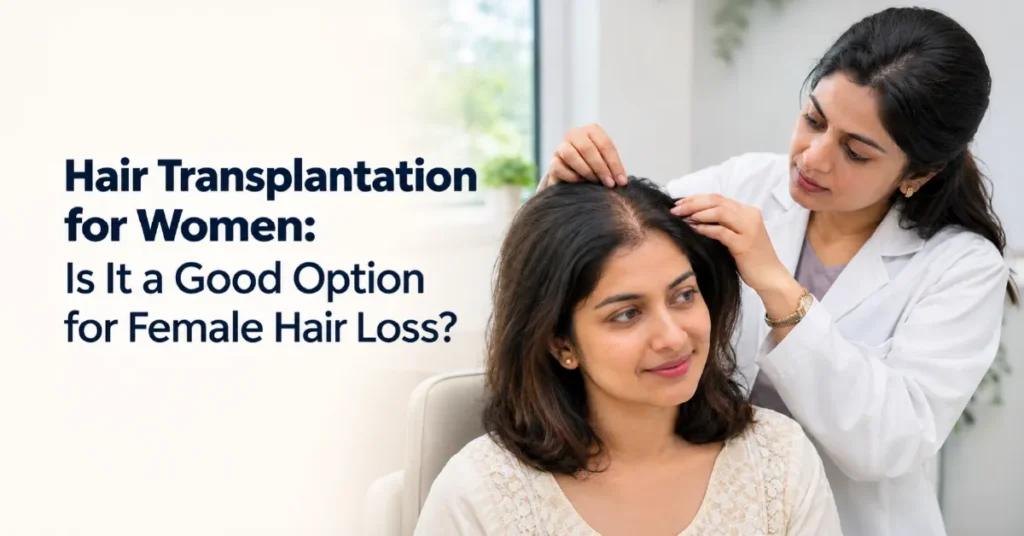
Though hair loss is a common condition, females specifically find it challenging to cope with it as it is considered an aspect of their identity. Those who have female pattern baldness will begin to witness hair loss initially before they turn 40, while over 10% of women experience hair loss during the pre-menopause phase[1]. A study also shows that about 56% of women in their 70s face visible hair loss, demanding early intervention to prevent it[2]. Though terms like baldness and hair loss are assumed to affect only males, most women have begun to develop female pattern baldness, and a considerable proportion of women will experience at least a minor degree of hair loss as they advance in age.
Women facing hair loss for a few months will experience distress and would be frantic to seek innovative methods to conceal it. Hair transplantation for women has become a popular treatment to reverse the effects of female pattern baldness and other hair loss concerns. This procedure helps cover the balding areas by implanting healthy grafts with active follicular units featuring the same growth pattern, colour, and texture. So, the outcomes of the hair transplant for women will be natural, have an exact hairline, and cannot be easily detected. Keep reading to understand more about female hair transplantation and why it can be a good treatment option.
How Does the Approach for Hair Transplantation for Women Differ?
Hair transplant is not just a hair restoration procedure performed for rectifying men’s balding and thinning issues. Women who are dealing with concerns like pattern hair loss, scarring traction alopecia, or hair loss due to a surgical procedure or medication can get permanent and natural results from hair transplantation for women. The way female hair transplantation differs from men’s procedure is not in terms of technology but the clinical approach it follows[3]. Males generally lose hair in a predefined pattern that remains progressive, leading to balding patches, thinning crowns, and receding hairlines. Women, on the other hand, are prone to diffuse hair thinning along the scalp’s crown, reduction in overall hair density, and widening hair parting. Such diffuse pattern hair loss can make it difficult to assess your candidacy and determine the right surgical technique and demands the intervention of a specialist surgeon with immense experience specifically to perform female hair restoration.
Why Surgeons Use a Unique Evaluation for Women’s Hair Loss?
-
Pattern of Hair Loss
For males, the candidacy determination can be straightforward as it only needs evaluation of the strength of the donor site and stability of hair loss to plan the procedure with a suitable outcome. However, for hair transplantation for women, the evaluation process is much more complex and unique. Hair loss and thinning in women is often caused by conditions like effects of medication, iron deficiency, androgenetic alopecia, hormone fluctuations, autoimmune conditions, thyroid imbalance, and telogen effluvium. Before considering a surgical procedure, your surgeon will thoroughly evaluate to identify the underlying issue causing hair loss, such as the driving factors, the stability of hair loss, and how responsive it will be to non-invasive options. Performing a hair transplant on individuals having progressive hair loss or a medically driven condition without correcting the underlying cause triggering it will offer unfavourable outcomes.
If you’re unsure what’s causing your thinning, see our guide to female hair loss diagnosis and treatment for common causes and treatment options.
-
Donor Area Analysis
Another major aspect of evaluation before hair transplantation for women is analysing your donor area. For people having male pattern baldness, the back and side of the head will have better hair density despite facing extreme hair loss. It indicates that these donor sites are abundant in DHT-resisting hair follicles, which are essential for a hair transplant. However, women often face diffuse thinning that can impact the donor site, limit the number of potential grafts, and make them unsuitable for hair restoration for women. An expert hair transplant surgeon would make a careful evaluation of the donor area before deciding the surgical technique.
Are You the Right Candidate for Hair Transplantation for Women?
Your candidacy for hair transplantation for women is more selective than for males. The indicators mentioned below are clear-cut indicators of who is the right candidate for a female hair transplant[4].
You are an ideal candidate for hair transplantation for women:
- You have female pattern hair loss referred to as androgenetic alopecia that doesn’t progress actively, and there are enough donor follicular units at the side and back of the scalp [5].
- Women having excess hair loss due to traction alopecia that occurs due to wearing high-tension and tight hairstyles for a long time, featuring healthy follicles surrounding the head.
- Females facing scarring hair loss induced by trauma, injury, burns, or surgery like facelifts.
- Females having patchy hair loss in particular areas of the scalp instead of diffuse hair loss.
You are not a suitable candidate:
- You have hair thinning or diffuse unpatterned alopecia that might have already affected those potential donor sites, making it insufficient for transplantation[6].
- Those who have active and progressive hair loss with an unstable pattern.
- Your hair loss is caused by an autoimmune disease like alopecia areata that will make your transplanted follicular units get attacked by the immune system.
- Females who have very little donor site with scarce hair density irrespective of the cause.
Hair Transplantation for Women: Techniques
The two renowned techniques applied in hair transplantation for women are similar to the ones applied for men facing thinning and hair loss issues[7]. However, the application of these techniques, their technical details, and goals are different.
-
Follicular Unit Extraction
It is commonly referred to as the FUE technique and targets one follicular unit at a time and extracts it from the donor site with the help of a tiny punching device, while taking care that there are no linear scars. The recovery after Follicular Unit Extraction is quicker as the incision openings in the donor site are small and will heal faster. There will be no visible scars on the surgical site, making it perfect for women who love long hairstyles and don’t want any specific trace left by the procedure. Most women prefer the FUE procedure as it is precise, and extraction is performed on the targeted donor areas with strong follicular units[8]. Plus, there will not be any hairstyle restrictions while recovering from FUE.
-
Follicular Unit Transplantation
This hair transplant procedure involves extracting a narrow donor strip from the scalp and dissecting the follicular units one by one using a microscope. When compared to the FUE method, Follicular Unit Transplantation aims at yielding a huge number of grafts per session. It is the right choice for females who require extensive hair density and coverage while having enough donor density[9]. However, you must also be prepared for the linear scar this procedure will leave after transplantation, which can be concealed by maintaining normal hair length hairstyles. You might experience initial discomfort at the donor site where the strip was removed and have a longer healing time when compared to FUE.
Which Technique Is Best?
The surgeon will suggest FUT or FUE based on your:
- Scalp assessment
- Extent of coverage needed
- Traits of donor area
- Hairstyle preferences
Our FUE vs. FUT hair transplant guide compares how grafts are collected, what scarring to expect and how recovery differs.
Some of you might even benefit from a combination approach through several sessions of both FUT and FUE to achieve natural hair along with excellent density and coverage. A thorough evaluation by the surgeon will help in identifying the right technique or a combination approach based on your anatomy to meet your hair goals.
If you’re planning a consultation locally, our guide to hair transplant costs in Hyderabad explains what can affect the cost and what to ask about follow-up visits.
Why Hair Transplantation for Women Is a Good Treatment Option?
This question might be one of the significant questions that you might ask when considering hair transplant surgery. It is essential to understand why hair transplantation for women can be a perfect choice rather than assuming that a men’s hair transplant procedure will be suitable for females too.
-
Pattern of Hair Loss
Most males lose hair with a defined pattern featuring clear-cut demarcated hair loss regions and retention. For women, diffuse hair loss is common on the scalp’s top part while featuring front hairline retention. It also indicates that the surgical objective of most females would be improving density to the remaining hair instead of creating a hairline from scratch, making the surgical goal technically different.
-
Reliability of Donor Area
The donor area of males will be genetically DHT-resistant and will have high stability even while facing advanced grades of baldness. The donor areas of women will be compromised if facing diffuse thinning that demands thorough evaluation and conservative extraction to prevent damage to the donor area. As the permanent hair loss area is not fully defined, the donor zone is prone to thinning in the future.
-
Planning The Surgical Procedure
As a woman, your hair loss will appear diffused instead of focal, featuring graft distribution across a larger area, which requires high-end planning. It helps in achieving a uniform and natural outcome without any demarcation lines visible across the non-transplanted and transplanted areas. However, planning a female hair transplant procedure is highly complex as the surgeon has to deal with thinning zones without affecting the remaining follicles.
-
Candidacy Challenges
When compared to male counterparts, the hair loss in women needs an in-depth pre-surgical evaluation to identify treatable causes like hormone imbalance, thyroid irregularities, and iron deficiency. Such challenging factors make hair transplantation for women a suitable choice for females with extreme hair loss and thinning conditions. So, careful candidacy choice is essential for women’s hair transplant.
-
Aesthetic Objectives
Generally, hair transplant for men focuses on assessing the placement of hairline and achieving crown coverage. But for women, the assessment will be to determine the required scalp density and the placement of parting along the crown to fulfil aesthetic goals. However, it demands the work of an expert surgeon with aesthetic sensibility.
-
No Need to Shave Head
Women often avoid hair transplant for the fear of shaving their full head to facilitate restoration. However, modern transplant procedures require only trimming of donor hair, which would be covered by the surrounding hairs. So, it is easier to get back to work within days after a hair transplant without anybody noticing it.
Such factors are the sole reason why you need to look for a skilled and experienced hair transplant surgeon specializing in hair restoration for women to achieve the desired functional and aesthetic results. Book a hair transplant consultation with Kolors Hair & Skin in Hyderabad to discuss the cause of your hair loss, assess your donor area and find out whether surgery is suitable for you.
Reference Links:
- Ho CY, Chen JY, Hsu WL, Yu S, Chen WC, Chiu SH, Yang HR, Lin SY, Wu CY. Female Pattern Hair Loss: An Overview with Focus on the Genetics. Genes (Basel). 2023 Jun 23;14(7):1326. https://pmc.ncbi.nlm.nih.gov/articles/PMC10379895/
- Villani A, Ferrillo M, Fabbrocini G, Ocampo-Garza SS, Scalvenzi M, Ruggiero A. Hair Aging and Hair Disorders in Elderly Patients. Int J Trichology. 2022 Nov-Dec;14(6):191-196. https://pmc.ncbi.nlm.nih.gov/articles/PMC10075351/
- Queen D, Avram MR. Hair Transplantation in Women. J Drugs Dermatol. 2025 Sep 1;24(9):851-855. https://pubmed.ncbi.nlm.nih.gov/40911748/
- https://www.americanhairloss.org/hair-transplant-surgery/womens-hair-transplants/
- https://ishrs.org/hair-transplant-for-women/
- https://www.plasticsurgery.org/cosmetic-procedures/hair-transplantation-and-restoration/candidates
- Dinh QQ, Sinclair R. Female pattern hair loss: current treatment concepts. Clin Interv Aging. 2007;2(2):189-99. PMID: 18044135; PMCID: PMC2684510. https://pmc.ncbi.nlm.nih.gov/articles/PMC2684510/
- https://jddonline.com/articles/hair-transplantation-in-women-S1545961625P8988X
- https://turkjdermatol.com/article/10.4274/tjd.galenos.2025.36349.pdf
