
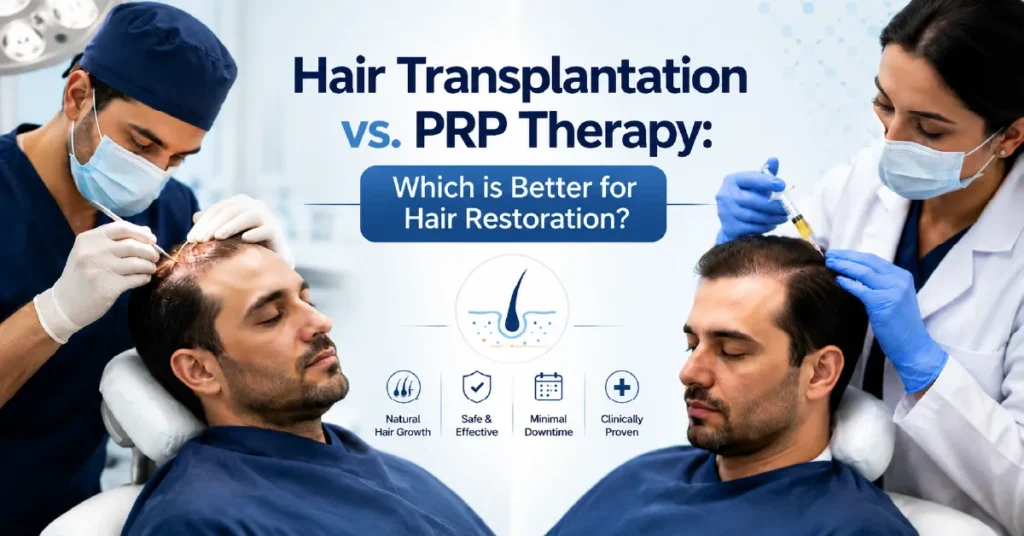
Hair loss remains a widespread concern across the globe, and with modern technological advancements, several treatments are available for effectively restoring hair. Among such modern treatments, hair transplants and Platelet-Rich Plasma therapy are highly popular[1]. While both these hair procedures focus on combating hair loss, they have significant differences in outcomes, mechanisms, and approach[2]. To understand which procedure works better for your hair loss concern, it is essential to weigh hair transplantation vs. PRP therapy. You must also consider various factors such as extent of hair loss, your objective, expectations, and overall health before zeroing in on one treatment.
Understanding PRP Hair Restoration
PRP therapy is performed as an in-office procedure that is minimally invasive and is considered a safe and effective method to combat hair loss. It requires a tiny blood sample from your body, and the platelets are extracted in a centrifugal processor to achieve them in concentrated form to retain the natural growth factors. Your hair surgeon will then administer a shot containing platelet-rich plasma directly on the problematic scalp areas facing low hair density or thinning.
This platelet-rich plasma is injected directly into the scalp at areas of thinning or reduced density. The treatment uses your body’s natural growth factors to stimulate the dormant follicular units, stall the active growth stage of the prevailing hairs, and enhance the overall follicular environment[3]. Studies also show that PRP is an effective procedure for people having pattern hair loss referred to as androgenetic alopecia and other types of non-scaring hair loss conditions[4].
While most people will be required to take up to 4 PRP therapy sessions, initial sessions will have up to 6 weeks’ spacing between them and periodically complemented by maintenance sessions. The outcomes of PRP sessions will be cumulative and gradual, which is a notable difference between hair transplantation vs. PRP therapy. PRP treatment will be effective for those who have healthy follicles that are not showing signs of good hair growth.
Benefits of PRP Therapy
- PRP therapy is a non-invasive treatment that has lower risks with less recovery time.
- The PRP treatment is performed using natural growth factors extracted from the patient’s blood, making it safe and free from allergies and side effects.
- This procedure is useful for people facing initial stages of hair thinning. It enhances the health of the hair follicles with slow hair growth, which is why it is not for balding people.
- PRP therapy is simple and swift, as one session needs half an hour to one hour with zero downtime. So, getting back to work is possible immediately.
- The outcomes of the PRP procedure will be gradually visible after some weeks, featuring thicker strands and healthy follicles that get better with every session[5].
Understanding Hair Transplant
Hair transplantation refers to an invasive procedure that involves relocating follicular units present in the donor site found along your scalp’s side or back to thinning or balding areas. Generally, there are two popular hair transplant techniques – FUE or follicular unit extraction[6] that removes hair follicles using tiny punch tools and FUT or follicular unit transplantation that involves scalp strip removal for follicular transplantation.
As the genes of transplanted follicles resist hormonal changes that trigger pattern hair loss, they will begin fresh hair growth in the recipient site that lasts longer, which is a key difference in hair transplantation vs. PRP therapy comparison. Hair restoration is ideal for people having well-pronounced or advanced hair loss in areas where the density of follicles has greatly decreased[7].
Hair transplantation needs local anaesthesia and has a longer recovery time than non-invasive procedures, and needs a skilled surgeon to perform it. Fresh hair sprouting from the follicular units will begin to surface within a 6-month period, and after 12 months, you will notice visible and full hair growth.
Benefits of Hair Transplantation
- Hair restoration procedures like FUE or FUT demand surgery and an expert hair surgeon for best outcomes.
- This procedure offers a long-term solution for hair loss concerns, as the transplanted follicles will begin their natural growth once the follicular units strengthen their roots[8].
- Hair transplants are a perfect solution for people facing extreme hair loss and bald patches on the scalp. It offers aesthetic appeal and enhances hair density.
- Hair restoration can be personalized to fulfil the specific requirements of patients, achieving a hairline that is natural through strategic hair follicle placement.
- Hair transplants are performed surgically, which requires you to spend some time recovering, and the outcomes will be visible after a few months.
Hair Transplantation Vs. PRP Therapy: Major Differences to Consider
Though both hair transplants and Platelet Rich Plasma therapy will help achieve better hair growth, you must realise that there are some key differences when comparing hair transplantation vs. PRP therapy[9].
-
Hair Treatment’s Longevity
- Hair Transplant: Hair restoration is a one-time treatment as the transplanted follicles during the procedure will begin hair growth naturally after a few weeks, offering a permanent solution[10].
- PRP Therapy: PRP treatment must be taken in multiple sessions spaced across a few months to maintain the outcome. Though it provides gradual results, it requires you to stay committed.
-
Cost Over Time
- Hair Transplant: Though the upfront cost of undergoing a hair restoration procedure might be slightly higher, it is a one-time procedure. This treatment is an investment that offers you permanent hair and saves money in the long run.
- PRP Therapy: Though one session of PRP lasting less than an hour might look affordable, it requires you to take multiple sessions. It would add up the cost and make it expensive over time.
-
Rate of Scarring
- Hair Transplant: Scarring risks differ based on the technique of hair transplant employed. The scarring risk is lower for the FUE procedure as the incision dots are barely visible, but linear scar risk is high in the FUT procedure.
- PRP Therapy: Being a non-surgical treatment, PRP therapy will not leave scars, which is suitable for people having concerns regarding visible scars.
-
Compatibility with Hair Types
- Hair Transplant: It is suitable for people having enough donor hair and adequate elasticity in the scalp. It is highly effective for people facing severe hair loss and steady donor sites.
- PRP Therapy: PRP is an effective choice for all hair types but relies mainly on the viability and health of the follicles that exist in the scalp.
-
Visibility of Results
- Hair Transplant: Though recovery after a hair restoration procedure might take some weeks, you will see new hair growing from the relocated follicles after a few months.
- PRP Therapy: The outcomes of the PRP procedure will be gradual, and you will notice improvement in hair growth with time; it needs several sessions to achieve better outcomes[11].
When PRP Therapy Will Be Useful?
While comparing the differences of hair transplantation vs. PRP therapy, you must know which treatment is best for you. PRP procedure will be helpful when you have active hair follicles but produce thin and weak hair. You can opt for PRP therapy if you have:
- Early hair thinning issue
- Active follicular units
- Need better hair density rather than coverage
- Demand a non-invasive procedure
- Follicular miniaturization or hair shedding issue
- Ready for maintenance sessions
When Is Hair Transplant Suitable?
A hair transplant is ideal for those who have inactive hair follicles that have stopped hair production and require donor follicles to restore hair growth. You can choose a hair transplant if:
- You have a receding hairline with stable hair loss
- Visible bald patches
- Progressive hair loss
- The follicles are not active in the balding area
- You have adequate donor hair to support transplantation
- You need more hair coverage on scalp
- You have realistic expectations regarding hair regrowth timeline and recovery
Parting Thoughts
As both hair procedures are very effective in curbing hair loss, it is essential to make a comparison of hair transplantation vs. PRP therapy to get a better understanding regarding their suitability. Selecting the suitable treatment approach depends on factors like the present situation causing hair loss or factors contributing to it, personal needs, and aesthetic goals. Schedule a consultation with the hair experts at Kolors Hair and Skin Clinic to discuss the right treatment option that perfectly caters to your needs and helps achieve an excellent outcome related to hair growth restoration.
Reference Links:
- https://ishrs.org/wp-content/uploads/2025/05/report-2025-ishrs-practice-census_05-12-25-final.pdf
- Xue P, Guo L, Dang E, Dou W, Zeng X, Fan X, Yang Q. A Prospective and Comparative Study to Explore the Effects of Platelet-Rich Plasma in Hair Transplantation for Patients With Androgenetic Alopecia. J Cosmet Dermatol. 2025 Feb;24(2):e16665. doi: 10.1111/jocd.16665. Epub 2024 Nov 18. PMID: 39555738; PMCID: PMC11845930. https://pubmed.ncbi.nlm.nih.gov/39555738/
- Nathan, N., & Senna, M. M. (2020, May 11). Platelet-rich plasma: Does the cure for hair loss lie within our blood? Harvard Health Publishing. https://www.health.harvard.edu/blog/platelet-rich-plasma-does-the-cure-for-hair-loss-lie-within-our-blood-2020051119748
- Kieling L, Konzen AT, Zanella RK, Valente DS. Is autologous platelet-rich plasma capable of increasing hair density in patients with androgenic alopecia? A systematic review and meta-analysis of randomized clinical trials. Anais Brasileiros de Dermatologia. 2024;99(6):847–862. https://www.sciencedirect.com/science/article/pii/S0365059624001363
- Erdhianto, A., Indrayani, A. W., & Juhanna, I. V. (2026). Effect of Platelet-Rich Plasma on Hair Growth and Graft Survival Following Direct Hair Implantation in Androgenetic Alopecia Patients. Journal of Advances in Medicine and Medical Research, 38(1) https://www.journaljammr.com/index.php/JAMMR/article/view/6036?__cf_chl_rt_tk=vgGQMv7UQcNgsn7J3fk8Xcr0H4uqKZEA0DpZhOPrrfk-1767676170-1.0.1.1-yx_.bVdRDhgV9OXVOc1oWi9RKQN5ZoU3wKAFoLGyFNc
- Sharma R, Ranjan A. Follicular Unit Extraction (FUE) Hair Transplant: Curves Ahead. J Maxillofac Oral Surg. 2019 Dec;18(4):509-517. doi: 10.1007/s12663-019-01245-6. Epub 2019 May 28. PMID: 31624428; PMCID: PMC6795649. https://pmc.ncbi.nlm.nih.gov/articles/PMC6795649/
- Goldin J, Zito PM, Raggio BS. Hair Transplantation. [Updated 2025 Aug 2]. In: StatPearls [Internet]. Treasure Island (FL): StatPearls Publishing; 2026 Jan- https://www.ncbi.nlm.nih.gov/books/NBK547740/
- Chouhan K, Roga G, Kumar A, Gupta J. Approach to Hair Transplantation in Advanced Grade Baldness by Follicular Unit Extraction: A Retrospective Analysis of 820 Cases. J Cutan Aesthet Surg. 2019 Oct-Dec;12(4):215-222. doi: 10.4103/JCAS.JCAS_173_18. PMID: 32001965; PMCID: PMC6967160. https://pmc.ncbi.nlm.nih.gov/articles/PMC6967160/
- Sindhusen S, Tawanwongsri W, Eden C. Efficacy of Platelet-Rich Plasma as an Adjunct to Hair Transplantation: A Systematic Review. Cureus. 2025 Oct 8;17(10):e94116. doi: 10.7759/cureus.94116. PMID: 41069573; PMCID: PMC12506585. https://pmc.ncbi.nlm.nih.gov/articles/PMC12506585/
- Razmi, T., & Subburaj, K. (2022). Hair Transplantation: A Brief Review. Clinical Dermatology Review, 6(2), 80–87. https://www.ovid.com/jnls/cddr/fulltext/10.4103/cdr.cdr_76_21~hair-transplantation-a-brief-review
- Pathania, V., Sood, A., Beniwal, N., Baveja, S., Shankar, P., & Patrikar, S. (2023). Randomized control trial to study the efficacy and safety of platelet-rich plasma as intraoperative holding solution in hair restoration surgery: A pilot study. Medical Journal Armed Forces India, 79(1), 46–53. https://www.sciencedirect.com/science/article/abs/pii/S0377123721001179
