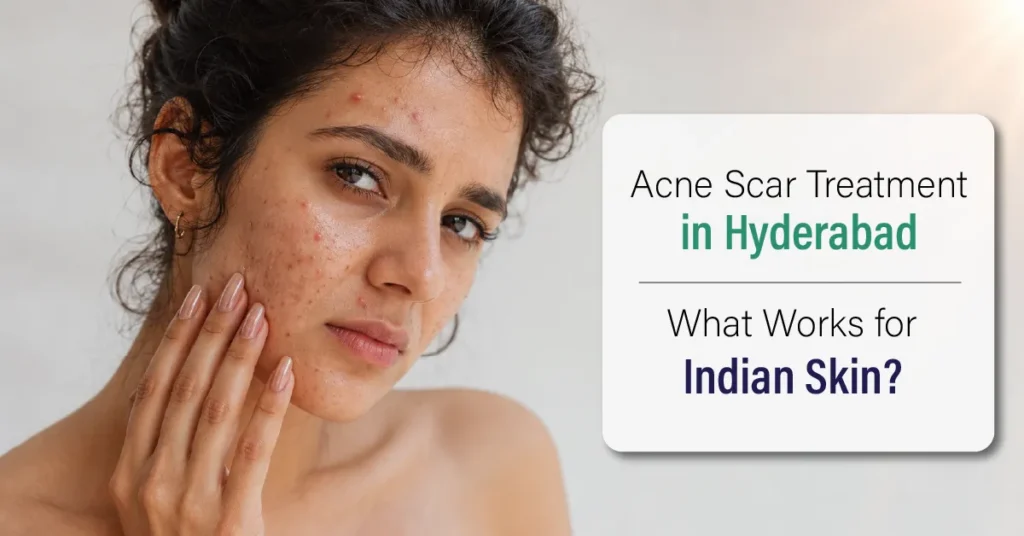
Are you one of those people who feels relieved that the pesky acne is gone but worried about the scars it leaves? You are not alone. More than 40% of people across the world are dealing with unsightly acne scars and acne breakouts. While acne scars found on the skin’s surface will fade away with time, the others residing in between the skin layers will be deeper. Such scars can make your skin look unsightly and flawed, requiring special acne scar treatment in Hyderabad. These acne scars can be easily identified by their texture, depth, and pockmarks that appear as depressions and indentations on the skin, which are the aftermath of persistent acne breakouts. It is essential to understand the type of acne scars to recognise which one you are dealing with to select the right treatment that can work wonders for your Indian skin.
Understanding Acne Scars
Acne scars refer to the skin’s permanent change in structure triggered by acne’s inflammation that doesn’t fade on its own like pigmentation or redness[1]. It demands specific acne scar treatment in Hyderabad to target the fibrous bands present inside the scars to break them down physically. It will help kindle fresh collagen production and encourage skin resurfacing for enhanced texture. It is essential to understand that one session of any acne scar treatment will not be enough to diminish those deep scars, as each session will contribute to overall improvement. At the end of 3 to 6 acne scar treatment sessions prescribed by your skin specialist, you will be able to notice about a 50 to 75% reduction in terms of visibility and depth of scars. For Indians, the selection of treatment will be influenced by the risk of developing PIH or post-inflammatory hyperpigmentation due to aggressive methods. This explains why skin surgeons pay more attention to the skin preparation, energy level settings, and choice of modalities.
Acne Scars: Their Types
The scars left by acne often vary in terms of appearance and size and are identified based on their types[2].
1. Rolling Scars
These scars are broad and create wavy undulations on the surface of the skin, induced by fibrous bands that bind the dermis with the subcutaneous tissue from within. These fibrous bands will pull your skin surface deeper to create a rolling indent. These scars have sloped edges and look uneven, making your face look scarred. Subcision is the major acne scar treatment in Hyderabad for rolling scars, which is performed with the needling technique to detach the fibrous bands to prevent tethering and help the scars rise up to the skin’s surface. Though skin resurfacing treatments will enhance your skin texture, they cannot uplift the rolling scar from the deep skin layers.
2. Icepick Scars
These scars look like V-shaped pits that are deep and narrow, that form on the skin’s surface and go deeper into the dermis to reach your subcutaneous fat. These scars look like punch-out dents that are tiny and hollow on your cheeks. Such deep acne scars are challenging to treat, which is why they demand a combination treatment approach. Fractional lasers alone will not be suitable for treating icepick scars, as the heat energy cannot reach the base of the narrow acne scars. So, a combination of subcision treatment, chemical peels, and laser skin resurfacing will be suitable for acne scars that are deep and persistent[3]. For personalized treatment, explore acne scar treatment in Hyderabad by Kolors to eliminate it and get flawless and smooth skin.
3. Hypertrophic and Keloid Scars
These scars are the aftereffect of too much collagen production when an acne begins to heal and leads to raised mounds of tissue on your shoulders, back, chest, and jawline. These scars would need a specialized approach to create a customised acne scar treatment in Hyderabad.
4. Boxcar Scars
These shallow and deep scars have a defined outline and are often found on your temples, cheeks, and jaw. These acne scars are highly responsive to several treatments like dermal fillers, chemical peels, microneedling, and fractional lasers. Treating these boxcar scars is much easier when compared to ice-pick scars.
5. Atrophic Macules
These scars appear to be mildly depressed and are soft and hyperpigmented, and appear as flat scars, changing the skin texture and colour. It is one of the mildest types of acne scars that are responsive to topical medications, chemical peels, and combination acne scar treatment in Hyderabad[4].
6. PIH / Post-inflammatory Hyperpigmentation
You will find acne leaving reddish or dark marks after it heals, which are not actually real scars but pigmentation. This type of scar is very common among Indians and will respond to acne scar treatment in Hyderabad, like laser toning and chemical peels.
Acne Scar Treatment for Indian Skin
Indian people have a fourth to fifth grade skin type based on the Fitzpatrick scale, making it prone to acne and resistant to anti-acne treatments. As these acne scar treatments are performed with heat energy, tissue injury, and controlled inflammation, Indians with dark skin will become darker due to high melanin production. They are also at a higher risk of developing PIH or Post-inflammatory Hyperpigmentation, which is worse than the acne scars.
However, such risks arise when inexperienced skin specialists apply CO2 lasers with poor calibration, which leave dark marks on Indian skin that will last up to a year. Using at-home chemical peels with aggressive ingredients will trigger PIH across the whole skin, which will be challenging to resolve when compared to actual acne scars. It is essential to consult a renowned skin specialist at a reputed skin clinic offering comprehensive acne scar treatment in Hyderabad to treat a specific scar type to get desired results. With several years of expertise, they will be able to prepare your skin before proceeding with the treatment, evaluate the suitable treatment for you based on your skin type, and suggest excellent post-treatment care instructions for active healing.
Top Acne Scar Treatments in Hyderabad
Now that you know which type of acne scar you have, the next step would be identifying the suitable procedure that will improve your skin texture and colour[5].
1. Laser Resurfacing
This acne scar treatment in Hyderabad is performed by introducing small columns of controlled heat to the area with acne scars. It begins to repair by improving collagen production to heal quickly and making uneven skin soft and lifted. This treatment is ideal for rolling scars and boxcar scars, as it penetrates through skin layers to rectify structural damage. The results of this treatment require time, and you might need 3 – 5 sessions with a couple of weeks spaced between them. For Indian skin, your surgeon will apply controlled laser light of low intensity to avoid dark skin patches while working on acne scars.
2. Microneedling
This acne scar treatment in Hyderabad, backed by radiofrequency, utilizes tiny needles when applying heat to the affected site. When the needles work on your skin, the RF energy will penetrate with controlled depth. Radiofrequency energy will kindle the production of collagen in the treatment area to eliminate scars from acne[6]. This procedure is useful for treating shallow and deep boxcar scars and rolling scars[7]. During this treatment, the skin surface is not affected, as RF is focused only on the scars. This treatment will need up to 6 sessions, and it can be combined with PRP based on the depth of the acne scar and skin type[8].
3. Subcision Treatment
This procedure is generally recommended for people dealing with rolling scars featuring fibrous strands binding with the deep skin tissue that pull it downwards. This acne scar treatment in Hyderabad targets the deep skin layers by using a tiny needle to reach the scars and release the fibrous bands. Then the scars that are depressed will begin to rise while healing completely. Most of the rolling acne scars will be healed in a single sitting, while the ones with deep tethering will require more sessions.
4. Dermal Fillers
If you have depressed acne scars that are very hollow, deep, and unsightly, then collagen treatments will not be effective. Dermal fillers with hyaluronic acid are suitable to relieve the depression created by acne scars and help lift them to reach the skin surface. It will offer noticeable results that will last up to a year.
5. PRP / Platelet-rich Plasma
This procedure is used as an adjunct therapy when planning acne scar treatment in Hyderabad by extracting your blood sample. Concentrated blood platelets extracted from it will induce growth factors to initiate skin repair. It can work perfectly with laser therapy or microneedling to erase deep scars quickly. This treatment encourages your skin to heal quickly and scars to disappear gradually. With time, you will also achieve healthy skin and promote texture.
6. Chemical Peels
This acne scar treatment in Hyderabad is performed by using special chemicals like salicylic acid or glycolic acid for skin exfoliation to eliminate the upper layer and allow new skin to develop from within that looks smooth and clear. Your surgeon will suggest between deep, medium, superficial, or mild strengths in chemical peels based on the extent of scars and their depth. You will have to attend several sessions to maintain and achieve aesthetically pleasing outcomes.
Duration Of Results After Acne Scar Treatment
The results of the acne scar treatment in Hyderabad tend to vary based on the healing ability of your skin and the depth of your acne scars.
- Deep Acne Scars: These scars will be present in your skin for several years, which is why they take more time to heal after treatment. You will begin to notice the scars fading after some months, which might take even a year.
- Medium Acne Scars: When the scars have well-defined depressions, they might require 3 – 6 months to notice visible improvements.
- Mild Acne Scars: These scars will be shallow, which is why you might not find any difference even after 3 sittings. At first, the skin surface will begin to show signs of improvement due to collagen production filling up the depressions left by the acne.
Parting Thoughts
Get ready for a scar-free journey with Kolors by scheduling an appointment with our skin experts today. Say goodbye to acne breakouts and scars, and say hello to smoother, more radiant, and flawless skin.
Reference Links:
- Connolly D, Vu HL, Mariwalla K, Saedi N. Acne Scarring-Pathogenesis, Evaluation, and Treatment Options. J Clin Aesthet Dermatol. 2017 Sep;10(9):12-23. Epub 2017 Sep 1. PMID: 29344322; PMCID: PMC5749614. – https://pmc.ncbi.nlm.nih.gov/articles/PMC5749614/
- Chilicka K, Rusztowicz M, Szyguła R, Nowicka D. Methods for the Improvement of Acne Scars Used in Dermatology and Cosmetology: A Review. J Clin Med. 2022 May 12;11(10):2744. doi: 10.3390/jcm11102744. PMID: 35628870; PMCID: PMC9147527. – https://pmc.ncbi.nlm.nih.gov/articles/PMC9147527/
- Garg S, Baveja S. Combination Therapy in the Management of Atrophic Acne Scars. Journal of Cutaneous and Aesthetic Surgery. – https://jcasonline.com/combination-therapy-in-the-management-of-atrophic-acne-scars/
- Hession MT, Graber EM. Atrophic acne scarring: a review of treatment options. J Clin Aesthet Dermatol. 2015 Jan;8(1):50-8. PMID: 25610524; PMCID: PMC4295858. – https://pmc.ncbi.nlm.nih.gov/articles/PMC4295858/
- Zhang M, Liu C, Zhang S, Chu R, Ren X. Advances in the treatment of acne scars. Frontiers in Medicine. 2025;12:1643035. doi:10.3389/fmed.2025.1643035. – https://www.frontiersin.org/journals/medicine/articles/10.3389/fmed.2025.1643035/full
- Fabbrocini G, Fardella N, Monfrecola A, Proietti I, Innocenzi D. Acne scarring treatment using skin needling. Clin Exp Dermatol. 2009 Dec;34(8):874-9. doi: 10.1111/j.1365-2230.2009.03291.x. Epub 2009 May 22. PMID: 19486041. – https://pubmed.ncbi.nlm.nih.gov/19486041/
- Adam G. Harris, Catherine Naidoo, Dedee F. Murrell, Skin needling as a treatment for acne scarring: An up-to-date review of the literature, International Journal of Women’s Dermatology, Volume 1, Issue 2, 2015. – https://www.sciencedirect.com/science/article/pii/S2352647515000295
- Fabbrocini G, De Vita V, Pastore F, Panariello L, Fardella N, Sepulveres R, D’Agostino E, Cameli N, Tosti A. Combined Use of Skin Needling and Platelet-Rich Plasma in Acne Scarring Treatment. Cosmetic Dermatology. 2011;24(4):177–183 – https://cdn.mdedge.com/files/s3fs-public/Document/September-2017/024040177.pdf
