
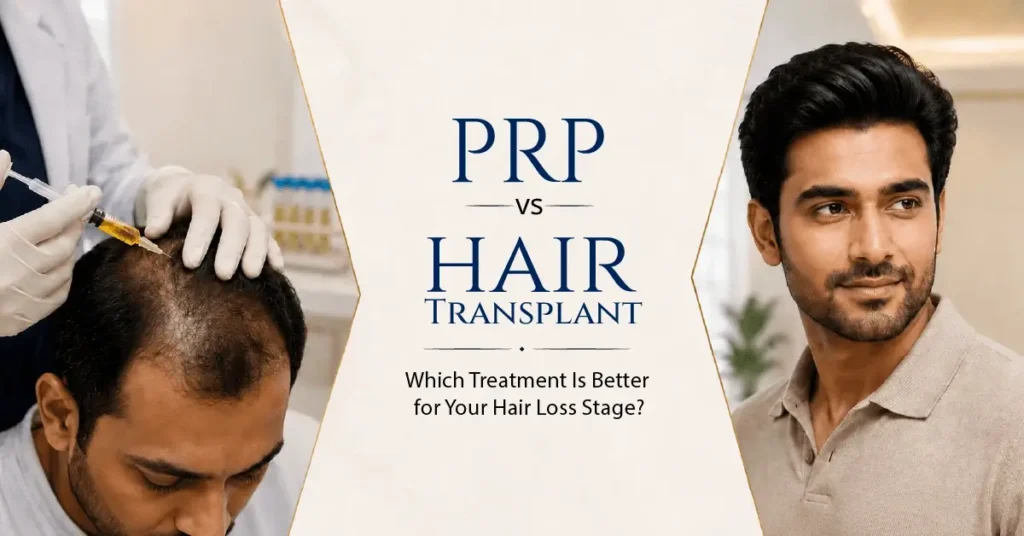
When on a search for a perfect hair restoration solution, you might come across two popular terms, which are surgical and non-surgical treatment methods. Of these treatment options, PRP and hair transplant procedures are very popular among men and women of different age groups. A 2025 study revealed that PRP was useful for promoting the satisfaction rate of patients by enhancing hair density, controlling hair loss, and increasing hair density among alopecia patients[1]. The report by ISHRS Census conducted in 2025 showed that hair transplant procedures are popular across the globe its member surgeons handling 178 hair transplantation surgical procedures each year[2]. Both these modern procedures focus on combating hair loss but tend to differ in terms of outcomes, method, and approach. It is essential to have a better understanding of the differences between PRP vs hair transplant to determine which treatment would be the best fit for a specific hair loss stage.
PRP Vs Hair Transplant: Why This Comparison Is Needed?
Losing hair every day is not an aesthetic issue, as it affects people’s personal relationships, client meetings, work discussions, and social life. Extreme hair loss will cause your hairline to retreat gradually, or your crown to become thinner with scantier hair growth. In such situations, it is essential to consider hair restoration options like PRP vs hair transplant. If you were of the idea that both these treatments for hair loss resolve it similarly, you need to rethink again. PRP or Platelet-Rich Plasma treatment is created to revive and boost hair growth by strengthening the weaker follicular units. It is ideal for people who face severe hair shedding, thinning, weak, and miniaturised follicles, even when hair is present. Hair Transplant procedure is a structured process that involves relocating active and strong hair follicles that are resistant to DHT by extracting from the donor site where there is a significant hair reduction or balding. While PRP improves follicular health by nourishing with blood plasma, hair transplant aims at replanting DHT-resistant follicles into balding areas. Both are result-driven procedures, but they are very different in terms of process, approach, and procedure.
How PRP Treatment Works?
When trying to compare PRP vs hair transplant, you must have a complete understanding of PRP and which stage of hair loss can be treated with it. PRP refers to a non-surgical treatment method that nurtures and treats the follicles using the concentrated natural growth factors present in your blood. A small amount of your blood will be drawn to be processed in a centrifugal mixer for releasing the platelets, and will be administered in the scalp using a special injection. This procedure involving blood platelet growth factor will promote hair growth by increasing hair thickness and density in the long run. PRP promotes blood circulation to the follicles to kindle the function of dermal papilla cells to support the transition from telogen or dormant stage to anagen growth stage[3].
Platelet-Rich Plasma treatment is ideal for people facing hair loss at an early age, and might have faced mild hair loss even at a younger age. It is essential to understand that, unlike hair transplant, PRP will not help in the development of new follicles, making it unfit for the total baldness condition. You will only experience tenderness and redness as temporary effects after PRP, and healing is quicker. You can see visible results after 3rd to 6th sessions, with several weeks spaced between each session. With time, you will notice that hair growth is stronger, denser, and thicker. However, you will need maintenance sessions to maintain the hair growth.
Why Choose PRP Therapy?
When deciding between PRP vs hair transplant, it is essential to consider the beneficial features of PRP, such as:
- PRP treatment is a non-surgical procedure, which is why it is not risky, comfortable, and has a short recovery.
- As it utilizes natural growth factors from your own platelets, there are no side effects, complications, or allergic reactions.
- PRP is very effective in treating hair thinning or hair loss at an early stage. This therapy works by enhancing follicular health, making it unsuitable for baldness[4].
- A session of PRP therapy is short and requires between 30 and 60 minutes, enabling you to return to regular activities soon after without any recovery period.
- The outcome of PRP therapy will be gradually visible, showing positive changes in overall hair health and thickness after some sessions.
For Which Stage of Hair Loss Is PRP Suitable?
PRP therapy utilizes growth factors present in your blood to stimulate the activity of follicles that were dormant and caused hair loss. It is effective for people who have active hair follicles but are underperforming owing to DHT activity and miniaturisation of follicular units.
- It is suitable for people facing the moderate to early stage of androgenetic alopecia, but who have healthy hair follicles when detected by trichoscopy[5].
- The level of thinning on your scalp that is visible to the naked eye cannot determine the suitability of PRP.
- PRP doesn’t employ any innovative mechanism to develop new hair follicles.
- You cannot find any improvement or changes if PRP is applied to an area on the scalp that doesn’t have any active follicles.
- It is usually advised after a hair transplant to strengthen the existing hair found around the implanted zone.
How Does Hair Transplant Procedure Work?
Hair transplant procedure is surgically performed for extracting and relocating active follicular units from a healthy donor site to the recipient area with scanty hair growth[6]. The three major hair transplant techniques are FUT, FUE, and DHI. Keep reading to know more about these modern hair restoration techniques.
Follicular Unit Extraction
FUE is performed by extracting the hair follicles one by one from the scalp’s donor site, present at the sides and back, that are filled with DHT-resistant follicular units[7]. Follicles present in the donor region are also resistant to hormonal changes, leading to patterned hair loss. A single follicular unit will naturally grow as a cluster containing up to 4 hair strands. The surgeon handling the FUE procedure will make tiny punches measuring between 0.6 mm and 1,0 mm in diameter for extracting follicles. Every FUE session will have 4000-plus grafts extracted and implanted in the recipient area on your scalp for optimum coverage.
Follicular Unit Transplantation
During the FUT procedure, your surgeon will surgically remove a tiny scalp tissue strip present in the donor site. The extracted strip will be placed under a microscope for dissection to collect follicles separately. The extracted follicular units will be implanted in the recipient who is facing hair thinning. This hair transplant procedure is best suited to gather more grafts per session, but the donor area will feature a linear scar after the procedure.
Both FUT and FUE techniques will be performed only after administering anaesthesia, as they involve both extraction and implementation. Each session may require 4 to 8 hours based on your graft requirement, and complete hair growth will be visible in one to one and a half years.
Direct Hair Implantation
This DHI transplant technique will be performed only at reputed modern clinics in Hyderabad, as it requires advanced equipment and a skilled surgeon. This process is performed with the help of a special DHI implantation device to implant the follicles without making any incisions. This hair transplant surgery is highly precise in terms of angle, direction, and depth while implanting follicles. It offers natural outcomes, has higher graft survival rates, and swift recovery.
Why Choose Hair Transplant?
When analysing PRP vs hair transplant, discussing the beneficial features of the hair restoration procedure is essential, such as:
- Modern hair restoration techniques like FUE, FUT, or DHI will be performed by a well-experienced surgeon, which is why you will be able to get visible results in a few months.
- Hair transplant procedures offer long-lasting outcomes, making them an excellent choice for pattern hair loss and bald patches[8]. As soon as the implanted hair follicles settle down in the recipient site, they will begin their natural growth cycle to prevent hair loss.
- Hair transplant techniques are focused on restoring hair growth in large bald areas and thinning patches. When performed by an expert surgeon, these procedures offer excellent aesthetic improvement by promoting hair thickness and density.
- Hair transplant surgery can be customised to cater to your specific hair loss needs. Plus, you will be able to get a natural hairline that complements your face, and hair follicles will be strategically located to create a natural look.
When Hair Transplant Is Ideal for Hair Loss?
1. Progressive Hair Loss
Your surgeon would advise choosing a hair transplant instead of PRP when there is progressive hair loss beyond reversal and follicles are permanently damaged.
2. Absence of Follicles
If there are no DHT-resistant follicles in the balding or thinning area, PRP will not help. Hair transplant surgery helps in restoring density by implanting active follicles.
3. Grade 3 Hair Loss
If you are facing baldness with a defined pattern representing Norwood Grade 3 for more than a year but have enough donor density, you are an ideal candidate for transplant surgery[9].
4. Follicular Damage
If you have already undergone PRP therapy but did not experience any improvement, such as controlled shedding or improved density, it indicates follicular damage. It cannot be reversed and needs to be replaced through implantation.
5. Receding Hairline
If your front hairline is receding but follicles and hairline near temples are well-defined and stable, you will need a hair transplant. Though PRP can slow down hair loss from progressing, it cannot recreate a receding hairline.
6. Combined Treatment
Some patients will need a combination of hair transplant as well as PRP for restoring hair loss. While transplantation restores follicular density to kindle hair regrowth, PRP will manage the hair loss in non-transplanted sites on the scalp[10]. However, the decision to opt for combined treatment will be your surgeon’s call based on assessment and not your individual preference.
PRP vs hair transplant: Key Differences to Consider
Though both hair transplant procedures and PRP therapy are effective and safe hair loss solutions, there are some major differences between PRP vs hair transplant that cannot be ignored.
1. Treatment Longevity
- Hair Transplant: This procedure is considered a one-time treatment as the transplanted follicles will initiate natural hair growth, offering a long-term solution.
- PRP: This therapy requires PRP maintenance sessions repeatedly, once every couple of months, to maintain hair growth results. In short, it requires you to stay committed to maintain the outcome.
2. Cost in the Long Run
- Hair Transplant: Even though the upfront hair transplant cost is a bit higher, you must understand it is a one-time investment offering long-term results. It is a cost-effective treatment that offers permanent hair restoration results in the long run.
- PRP: Though each session of PRP is available within an affordable range, the requirement for repeated sessions to maintain the results will increase the cost in the long run.
3. Scarring Potential
- Hair Transplant: Scarring risk tends to vary based on the hair transplant technique used to treat balding or thinning. While the FUE technique leaves minimal scars similar to dots, DHI or FUT will leave a linear scar that might be visible among individuals with short hairstyles.
- PRP: It is a non-invasive procedure that does not cause any scarring, making it a suitable choice for those who don’t like scars on the scalp.
4. Hair Type Suitability
- Hair Transplant: It is ideal for men and women having enough donor hair, especially at the sides and back of the head, along with adequate scalp elasticity. It is effective for people facing advanced hair loss while having donor area stability.
- PRP: This treatment option will suit all hair types, while its effectiveness will mostly rely on the viability and health of follicles.
5. Results: Gradual vs Immediate
- Hair Transplant: Your initial recovery period might take a couple of weeks after a transplant, as the baby hair will sprout only after the implanted follicles settle well. Once the hair growth is visible, its length and density will improve in the coming months to offer a permanent hair growth outcome in a few months.
- PRP: The outcomes of PRP therapy will be gradual, as there will be improvement in hair growth with time. You will have to undergo several PRP sessions to get the desired results.
Parting Thoughts
The analysis of PRP vs hair transplant would have made you understand that both are effective solutions to treat hair loss, but each is distinct to meet varying needs based on hair loss stages. PRP is ideal to treat early onset of hair loss by a non-invasive process to boost hair growth by injecting platelet-derived growth factor. Hair transplant is a permanent choice to treat progressive and advanced hair loss by extracting and transplanting the follicular units in balding areas for new hair growth. Consult the hair experts at Kolors Hair and Skin Clinic to decide the best option for your hair loss stage to put an end to hair loss.
Reference Links:
- Xue P, Guo L, Dang E, Dou W, Zeng X, Fan X, Yang Q. A Prospective and Comparative Study to Explore the Effects of Platelet-Rich Plasma in Hair Transplantation for Patients With Androgenetic Alopecia. J Cosmet Dermatol. 2025 Feb;24(2):e16665. doi: 10.1111/jocd.16665. Epub 2024 Nov 18. PMID: 39555738; PMCID: PMC11845930. – https://pubmed.ncbi.nlm.nih.gov/39555738/
- ISHRS. 2025 ISHRS Practice Census Results. International Society of Hair Restoration Surgery, 2025. – https://ishrs.org/wp-content/uploads/2025/05/report-2025-ishrs-practice-census_05-12-25-final.pdf
- Erdhianto, A., Indrayani, A. W., & Juhanna, I. V. (2026). Effect of Platelet-Rich Plasma on Hair Growth and Graft Survival Following Direct Hair Implantation in Androgenetic Alopecia Patients. Journal of Advances in Medicine and Medical Research – https://www.journaljammr.com/index.php/JAMMR/article/view/6036?__cf_chl_rt_tk=vgGQMv7UQcNgsn7J3fk8Xcr0H4uqKZEA0DpZhOPrrfk-1767676170-1.0.1.1-yx_.bVdRDhgV9OXVOc1oWi9RKQN5ZoU3wKAFoLGyFNc
- Nathan, N., & Senna, M. M. (2020). Platelet-rich plasma: Does the cure for hair loss lie within our blood? Harvard Health Publishing. – https://www.health.harvard.edu/blog/platelet-rich-plasma-does-the-cure-for-hair-loss-lie-within-our-blood-2020051119748
- Lucas Kieling, Ana Terezinha Konzen, Rafaela Koehler Zanella, Denis Souto Valente, Is autologous platelet-rich plasma capable of increasing hair density in patients with androgenic alopecia? A systematic review and meta-analysis of randomized clinical trials, Anais Brasileiros de Dermatologia, Volume 99, Issue 6, 2024 – https://www.sciencedirect.com/science/article/pii/S0365059624001363
- Goldin J, Zito PM, Raggio BS. Hair Transplantation. [Updated 2025 Aug 2]. In: StatPearls [Internet]. Treasure Island (FL): StatPearls Publishing; 2026 Jan – https://www.ncbi.nlm.nih.gov/books/NBK547740/
- Sharma R, Ranjan A. Follicular Unit Extraction (FUE) Hair Transplant: Curves Ahead. J Maxillofac Oral Surg. 2019 Dec;18(4):509-517. doi: 10.1007/s12663-019-01245-6. Epub 2019 May 28. PMID: 31624428; PMCID: PMC6795649. – https://pmc.ncbi.nlm.nih.gov/articles/PMC6795649/
- Razmi, T Muhammed; Subburaj, Kiruthika1. Hair Transplantation: A Brief Review. Clinical Dermatology Review 6(2):p 80-87, Jul–Dec 2022. | DOI: 10.4103/cdr.cdr_76_21 – https://journals.lww.com/cddr/fulltext/2022/06020/hair_transplantation__a_brief_review.5.aspx
- Chouhan K, Roga G, Kumar A, Gupta J. Approach to Hair Transplantation in Advanced Grade Baldness by Follicular Unit Extraction: A Retrospective Analysis of 820 Cases. J Cutan Aesthet Surg. 2019 Oct-Dec;12(4):215-222. doi: 10.4103/JCAS.JCAS_173_18. PMID: 32001965; PMCID: PMC6967160. – https://pmc.ncbi.nlm.nih.gov/articles/PMC6967160/
- Sindhusen S, Tawanwongsri W, Eden C. Efficacy of Platelet-Rich Plasma as an Adjunct to Hair Transplantation: A Systematic Review. Cureus. 2025 Oct 8;17(10):e94116. doi: 10.7759/cureus.94116. PMID: 41069573; PMCID: PMC12506585. – https://pmc.ncbi.nlm.nih.gov/articles/PMC12506585/
