Introduction: Understanding Skin Rejuvenation Treatments
Exposure to the sun, heredity, and skin issues can lead to skin irregularities in your body, specifically your face. Other factors like exposure to pollutants, stress, and not following a proper skincare routine might cause changes in skin texture, leading to the development of acne scars, wrinkles, sunspots, freckles, and skin pigmentation. With age, your skin will begin to lose its elasticity, causing a reduction in firmness, suppleness, and glow. Advanced skin rejuvenation treatments help in eliminating all traces of skin damage and irregularities to make you look younger and flawless[1]. Treatments like laser toning and chemical peels are created specifically to enhance the appearance of your overall skin by removing wrinkles as well as fine lines. These skin rejuvenating treatments will not only leave your skin glowing but can also address pigmentation-related issues like sunspots or age spots and acne scars[2]. Both chemical peels and laser toning skin treatments can be beneficial for improving the skin tone and texture of your overall face or in specific areas like near the eyes or mouth. Keep reading as we dig further to help you understand the differences between laser toning vs. chemical peels, their effectiveness, cost, and more.
What is Laser Toning? Procedure, Benefits, and Ideal Candidates
Laser toning refers to an advanced skin procedure that helps in skin lightening, rejuvenating, and regeneration. It utilizes low-strength non-ablative Nd: YAg and Q-switch lasers to penetrate through your skin layers to perform pigment disintegration. It helps erase the effects caused by ageing, acne, and sun damage.
The Laser Toning Procedure
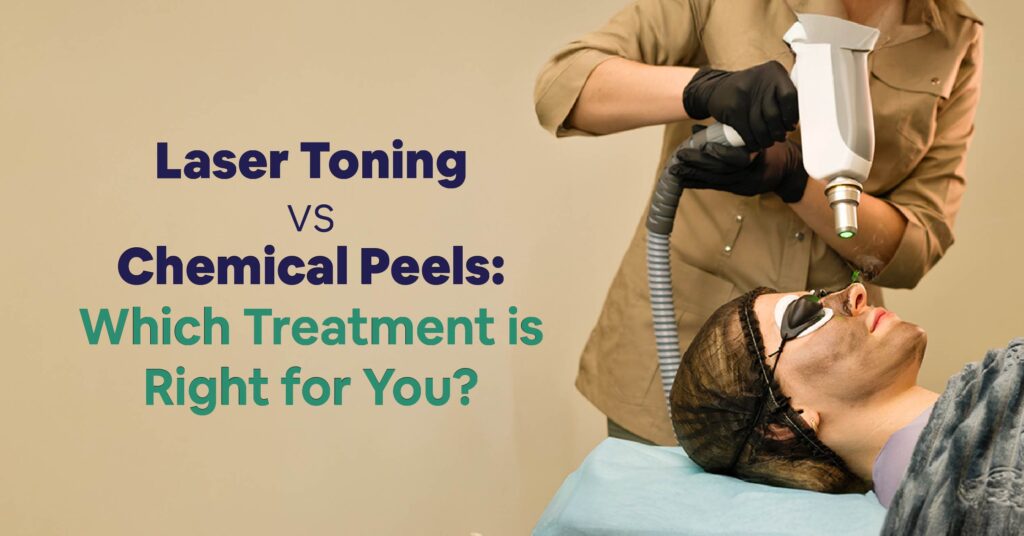
Laser toning procedure is performed by using Nd: YAg and Q-switch non-ablative lasers, and its low-fluence heat will focus on the melanosomes in the targeted area and will not affect the surrounding tissues. This procedure with laser induces a controlled thermal injury that triggers the natural mechanism of your body to promote elastin and collagen production[3]. Soon after a laser toning session, skin discoloration and irregularities begin to diminish as your body’s natural metabolic activities flush the pigmentation and melanin deposits away[4]. This painless and non-invasive laser procedure helps achieve firmer and glowing skin with an even tone[5]. It is suitable for erasing dark spots, chicken pox marks, melasma, wrinkles, hyperpigmentation, and wrinkles.
Laser Toning: Benefits
- As the laser toning procedure can lower excess melanin production in the body, it is easier to achieve an even skin tone. Plus, it erases blemishes, age spots, sun spots, and acne marks on the skin.
- You can stay assured of long-lasting outcomes after a laser toning procedure as your skin will stay free from blemishes, tan, and wrinkles for several months to years.
- As your skin will be free from irregularities like sun spots, melasma, tan, and acne marks, there will be a drastic improvement in your skin tone[6].
- Production of essential skin proteins like elastin and collagen will be promoted by the laser procedure within skin layers to make skin firmer, younger, and smoother.
- This skin rejuvenating procedure helps you achieve a youthful, glowing skin that is free from wrinkles and fine lines by treating the issues in the deep layers.
- As this procedure uses low-strength non-ablative with low-fluence, there is no damage to the skin’s surface. It promotes skin renewal and rejuvenation without any side effects.
- Getting back to your daily work and normal routine is possible after a laser toning session, as it is non-invasive and needs no downtime.
- People with different skin types can avail a laser toning procedure as it is safe and uses a non-ablative laser. There aren’t any risks like inflammation or pigmentation after the procedure.
- This non-invasive procedure, based on laser technology, doesn’t create any scabbing or inflammation on the skin after each session. There might be mild redness, which is temporary and will fade in a couple of hours.
- Laser skin rejuvenating procedure will help increase circulation within the layers, which is why it offers instant results after every session.
- It is a quick procedure that takes just 30 minutes to an hour per session. So, you can go for a laser toning appointment even if you have a busy work schedule.
Ideal Candidates for Laser Toning
You can undergo laser toning treatment if you have:
- Skin irregularities like age or sun spots, uneven tone, or pigmentation
- Huge and visible skin pores on your cheeks and nose
- Severe tanned skin on face, arms, and legs
- Pigmented skin, atrophic scars, erythematous, and acne marks
- Ageing signs like crow’s feet, wrinkles, and fine lines
What are Chemical Peels? How They Work and Who Should Consider Them
Chemical peels are exfoliating treatments that use skin-safe chemical solutions that contain trichloroacetic acid, alpha-hydroxy acids, or beta-hydroxy acids on damaged skin[7]. When applied to the skin, this chemical solution will work on the external layer to promote cell renewal and production of collagen. The controlled action of the chemical peels would exfoliate the skin only on the affected area to eliminate dead cells and to promote the formation of soft new skin[8]. It is useful for getting rid of mild scars, ageing effects, dark spots, acne, freckles, and photodamage. It is a painless procedure that might only leave a slight stinging or burning feeling. The results will be visible within a few days to weeks after your chemical peel sessions. Three types of chemical peels classified based on their action depth[9] are:
- Deep Peels: This type of chemical peel can penetrate through your reticular dermis to erase deep photoaging marks, wrinkles, and acne scars.
- Medium Peels: These chemical peels of medium depth will work on your papillary dermis layer for treating pigmentation, multiple solar keratoses, superficial scars, and dyschromia.
- Superficial Peels: These chemical peels are effective in dealing with the irregularities found on your skin’s superficial layer. It is useful to treat skin conditions like melasma and acne[10].
Chemical Peels: Ideal Candidates
- People who have skin concerns like hyperpigmentation, wrinkles, fine lines, freckles, sun spots, acne, and melasma[11].
- Those who love to improve their skin radiance and texture
Key Differences Between Laser Toning and Chemical Peels
1. Effectiveness for Pigmentation, Dullness, and Skin Texture
- Laser Toning: It is beneficial for people with PIH or post-inflammatory hyperpigmentation, sun spots, freckles, and melasma. It is perfect for all skin types, including dark skin shade, dull and damaged skin, sun-damaged skin, and aging skin with deep wrinkles.
- Chemical Peels: These peels are suitable for reducing post-inflammatory hyperpigmentation, uneven skin tone, aging skin, and dark spots[12]. It is ideal for all skin types, but specifically for lighter skin tones. For dark skin tone, consult your doctor and then proceed.
2. Side Effects: What to Expect
- Laser Toning: Common side effects might be mild discomfort, peeling, swelling, and redness, which are temporary. Serious but rare side effects include scarring, redness, and hyperpigmentation.
- Chemical Peels: Mild side effects of mild peels might be mild peeling and redness. People with darker skin tone might develop scarring issues or hyperpigmentation. Deep peels might cause redness, scabbing, and swelling, while medium-depth peels might induce sensitivity and flaking.
3. Recovery Time: What to Expect
- Laser Toning: This procedure is performed with a non-ablative laser, which is why there is no recovery time. There might be slight sensitivity, mild redness, and swelling that will subside within a day.
- Chemical Peels: Superficial peels will require just 1 to 3 days for recovery to bring down flaking and slight redness. Deep chemical peels will need a few weeks or even months, along with regular follow-ups for healing quickly. Medium peels might need up to 10 days of downtime for severe dryness and visible peeling.
Cost Comparison: Laser vs. Chemical Peels
- Laser Toning: Every session of laser toning treatment will cost between Rs. 6500 and Rs. 10,000. To get rid of fine lines and wrinkles, you will have to spend between Rs. 8000 and Rs. 15000 per session, while for melasma and pigmentation, it would be between Rs. 7000 and Rs. 10000 per session.
- Chemical Peels: The cost of a superficial chemical peel will be between Rs. 1500 and Rs. 5000 per session. For a deep peel session, the cost will be around Rs. 20,000 – Rs. 50,000. Medium chemical peels will cost between Rs. 5000 and Rs. 15000 for a single session.
Choosing the Right Treatment for Your Skin Type
The decision to opt for a perfect skin rejuvenating treatment relies on your skin concerns, budget, and type. If you are on the lookout for a quick fix like smoother skin and enhanced texture, chemical peels can be an ideal choice. But if deep wrinkles and scars are bothering you, laser toning can be a game-changer.
Conclusion: Making an Informed Decision
Though chemical peels and laser toning are effective treatments, consult a skin specialist at Kolors Hair and Skin to discuss your options. The skin specialist will help you determine the right skin rejuvenating treatment to take care of the skin concerns and achieve your skin goals.
Reference Links:
- American Society of Plastic Surgeons. Skin rejuvenation and resurfacing. Available from: – https://www.plasticsurgery.org/cosmetic-procedures/skin-rejuvenation-and-resurfacing
- Morris, M.X.; Gebhardt, S.; Tingen, J.N.; Dorante, M.I.; Pandya, S. Laser Resurfacing Versus Chemical Peels: A Review of Current Trends and Technological Advances in Nonsurgical Facial Rejuvenation. J. Aesthetic Med. 2025, 1, 5. – https://www.mdpi.com/3042-6774/1/1/5
- Wenzel GI, Anvari B, Mazhar A, Pikkula B, Oghalai JS. Laser-induced collagen remodeling and deposition within the basilar membrane of the mouse cochlea. J Biomed Opt. 2007 Mar-Apr;12(2):021007. doi: 10.1117/1.2714286. PMID: 17477714; PMCID: PMC3651902. – https://pmc.ncbi.nlm.nih.gov/articles/PMC3651902/
- Lee YJ, Shin HJ, Noh TK, Choi KH, Chang SE. Treatment of Melasma and Post-Inflammatory Hyperpigmentation by a Picosecond 755-nm Alexandrite Laser in Asian Patients. Ann Dermatol. 2017 Dec;29(6):779-781. doi: 10.5021/ad.2017.29.6.779. Epub 2017 Oct 30. PMID: 29200769; PMCID: PMC5705362. – https://pmc.ncbi.nlm.nih.gov/articles/PMC5705362/
- Kim C, Gao JC, Moy J, Lee HS. Fractional CO2 laser and adjunctive therapies in skin of color melasma patients. JAAD Int. 2022 Jul 20;8:118-123. doi: 10.1016/j.jdin.2022.02.010. PMID: 35875396; PMCID: PMC9305318. – https://pmc.ncbi.nlm.nih.gov/articles/PMC9305318/
- Sarkar R, Aurangabadkar S, Salim T, Das A, Shah S, Majid I, Singh M, Ravichandran G, Godse K, Arsiwala S, Arya L, Gokhale N, Sarma N, Torsekar RG, Sonthalia S, Somani VK. Lasers in Melasma: A Review with Consensus Recommendations by Indian Pigmentary Expert Group. Indian J Dermatol. 2017 Nov-Dec;62(6):585-590. doi: 10.4103/ijd.IJD_488_17. PMID: 29263531; PMCID: PMC5724305. – https://pmc.ncbi.nlm.nih.gov/articles/PMC5724305/
- Samargandy S, Raggio BS. Chemical Peels for Skin Resurfacing. [Updated 2023 Oct 29]. In: StatPearls [Internet]. Treasure Island (FL): StatPearls Publishing; 2026 Jan-. – https://www.ncbi.nlm.nih.gov/books/NBK547752/
- Khunger N. A perspective on what’s new in chemical peels. Cosmoderma. Available from: – https://cosmoderma.org/a-perspective-on-whats-new-in-chemical-peels/
- Soleymani T, Lanoue J, Rahman Z. A Practical Approach to Chemical Peels: A Review of Fundamentals and Step-by-step Algorithmic Protocol for Treatment. J Clin Aesthet Dermatol. 2018 Aug;11(8):21-28. Epub 2018 Aug 1. PMID: 30214663; PMCID: PMC6122508. – https://pmc.ncbi.nlm.nih.gov/articles/PMC6122508/
- Karia U, Parghi M, Padhiar B, Shah B. A study of efficacy and safety of newer chemical peels for acne vulgaris grade 1 to grade 3 [Internet]. IP Indian J Clin Exp Dermatol. 2022 [cited 2026 Mar 09];8(3):180-185. Available from: https://doi.org/10.18231/j.ijced.2022.037 – https://ijced.org/archive/volume/8/issue/3/article/7826
- Kumari R, Thappa DM. Comparative study of trichloroacetic acid versus glycolic acid chemical peels in the treatment of melasma. Indian J Dermatol Venereol Leprol 2010;76:447 – https://ijdvl.com/comparative-study-of-trichloroacetic-acid-versus-glycolic-acid-chemical-peels-in-the-treatment-of-melasma/
- Sarkar R, Arora P, Garg VK. Cosmeceuticals for hyperpigmentation: What is available? Australasian Journal of Dermatology. – https://onlinelibrary.wiley.com/doi/10.1111/ajd.12715
