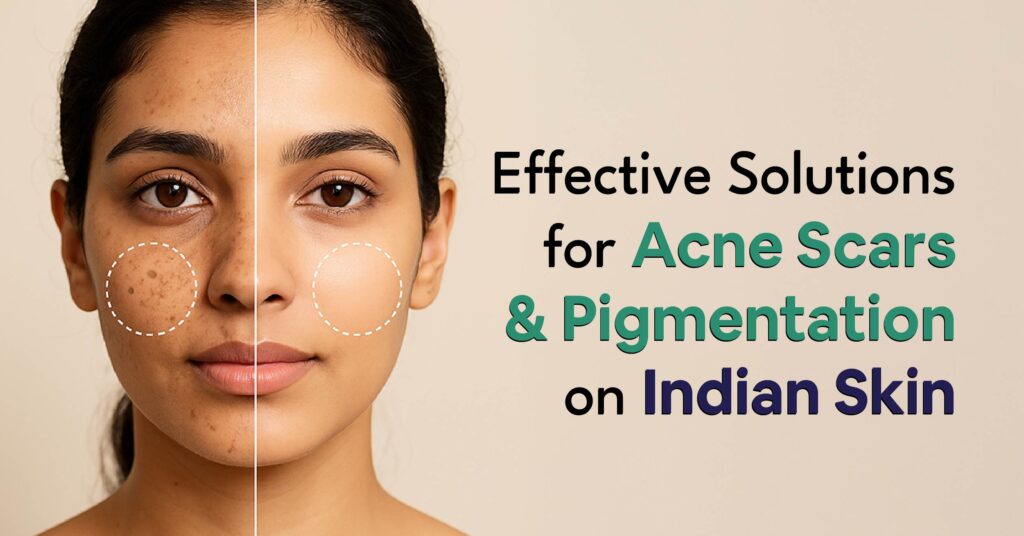
Diverse skin tones, ability to develop pigmentation, response to climatic changes, and acne breakouts make Indian skin very unique. Indians are known for having skin tones that range from darker to lighter, falling within the wheatish spectrum. Indian skin falls under Type IV to VI in the Fitzpatrick scale, characterized by a high melanin content, which makes it naturally protective against direct sunlight; however, it is also prone to acne and hyperpigmentation. The distinct features of Indian skin include:
- High Melanin: Indian skin has sun protection ability, making it prone to developing pigmentation and dark spots.
- Oily Skin: As the skin of Indians has a lot of sebaceous glands and naturally thick texture, there is a high level of oil secretion, leading to acne breakouts and blackheads.
- Environment Sensitivity: Indian skin is prone to damage caused by UV exposure, humidity, and pollutants. Such factors will lead to frequent acne breakouts, dullness, and sensitivity.
- Combination Skin: Most Indians have combination skin featuring dry or normal cheeks and oil-prone T-zone.
It is estimated that about 85% of Indians between the age group of 18 to 24 years face acne, and 60% among them had post-inflammatory hyperpigmentation after a few days[1]. Unlike other countries, Indians face acne even after they become adults, even after they cross 45 years[2],[3]. Keep reading to understand more about acne scars and pigmentation, their types, and topical and professional treatments available for making a well-informed decision.
Understanding Acne Scars and Pigmentation
Both hyperpigmentation and acne scars are normal skin concerns that Indians might have to deal with at some point in time, as they can develop at any age. Both these bothersome skin issues tend to develop as soon as your acne heals, leading to deep marks and uneven tone affecting your self-esteem. Acne scars can vary in size and appearance and are often caused by inflammation triggered by acne lesions[4].
Hyperpigmentation develops when specific skin areas turn darker than the rest of the body. People with darker skin tone are more prone to developing this skin condition. This skin condition occurs when melanin production is excessive, and this pigment determines your skin tone. Soon after acne lesions develop and heal, PIH or post-inflammatory hyperpigmentation occurs to trigger the development of black spots. Several factors, like specific medications, too much exposure to the sun, and alterations in hormones, will cause hyperpigmentation. Trying to pick or squeeze an acne might cause hyperpigmentation and scarring.
Types of Acne Scars Common in Indian Skin
Acne scars in India are classified as:
- Sunken / Atrophic Acne Scars: These acne scars are highly visible on your skin surface and occur due to less collagen production[5]. These scars are classified as:
- Boxcar Scars: These scars appear in a U-shape and look shallow, deep, and wide, featuring sharper edges along the jawline and cheeks.
- Ice Pick Scars: This acne scar type mimics the shape of an icepick, featuring a narrow-looking bottom and wider top. They develop along your forehead and upper cheeks, having thin skin.
- Rolling Scars: Such wide-looking acne scars appear as depressions with round and irregular edges. These marks can create a wave-like or uneven look on your skin and can be found on your lower cheeks and jawline.
- Raised / Hypertrophic Acne Scars: This type of acne scar develops when your body secretes more collagen while healing, leading to a raised look on the skin.
- Keloid Scars: It is also another type of hypertrophic scars that look similar to raised bumps. These acne marks often cover the skin surrounding the areas where acne lesions were present earlier.
Causes of Pigmentation and Dark Spots
Here’s why your skin develops dark skin and pigmentation:
UV Rays Exposure
The major cause behind your age spots or dark spots, referred to as solar lentigines and uneven skin, is exposure to UV rays. It causes excess melanin production by kindling melanocytes, which causes sun damage.
Melasma-related Hormonal Fluctuations
While you are pregnant, it is common to experience fluctuations in hormone levels that might make your face develop dark patches, causing an uneven look. You might also face hormonal alterations while taking birth control pills or undergoing hormone therapy.
PIH Or Post-Inflammatory Hyperpigmentation
This skin condition occurs soon after an irritation or injury, such as eczema, burns, psoriasis, acne lesions, and cuts.
Ageing Skin
With age, your skin tends to mature, which leads to the production of excess pigment cells. It causes the accumulation of solar lentigines, liver spots, or age spots.
Medications for Specific Conditions
Specific medications like chemotherapy drugs, NSAIDs, or nonsteroidal anti-inflammatory drugs and antibiotics might trigger pigmentation or acne breakouts as side effects. Medical conditions like Vitamin B12 deficiency and thyroid dysfunction might also cause these skin concerns.
Exposure to Environmental Factors
Sometimes, environmental pollutants and smoking will cause oxidative stress and lead to uneven pigmentation.
Inflammation / Friction
Chronic skin irritation caused by rubbing or wearing tight clothes might cause thickening of the skin and excess melanin production in the inner thighs, neck, and underarms.
Topical Treatments: Creams, Serums, and Home Remedies
You can discuss topical treatments with your dermatologist to get rid of acne scars and pigmentation marks. The topical solutions should contain one or more of these active ingredients:
- Ascorbic Acid / Vitamin C: This ingredient is a potent antioxidant that can combat melanin formation and brighten your skin. You can use it as a morning serum, and it will help fade dark spots within 12 weeks.
- Vitamin B3 / Niacinamide: Serums or creams with this powerful ingredient help prevent skin pigmentation and serve as a skin barrier while keeping down redness.
- Azelaic Acid: Serums, creams, or lotions containing this effective ingredient help treat pigmentation, redness, and acne. It has a gentle formulation and is well-tolerated by all skin types.
- Retinol / Retinoids / Adapalene: The topical products with this active ingredient are used to enhance uneven skin tone and texture, and diminish dark spots.
- AHAs / BHAs: Topical products containing BHAs and AHAs like Salicylic acid and Glycolic acid perform exfoliation and lighten pigmentation and age spots. If you have acne-prone skin, you can use serums and lotions with Salicylic acid.
- Hydroquinone: This active ingredient has skin-lightening properties and lowers the production of pigment.
- Other Ingredients: You can opt for products with licorice root extract, alpha arbutin, and kojic acid to cut down melanin production, inhibit tyrosinase, and reduce dark spots.
Home Remedies
You can try home remedies with natural ingredients such as:
- Gel of Aloe Vera: Known for its healing ability, this plant gel gradually soothes, heals, and lightens dark spots and acne marks.
- Honey: It has antibacterial properties and will heal skin to make it smooth. It is useful for reducing scarring and clearing acne marks with time.
- Extracts of Green Tea: This antioxidant-rich ingredient will help clear pigmentation and inflammation when applied regularly.
- Turmeric Paste: This paste, using raw turmeric, has anti-inflammatory and antifungal properties to prevent pigmentation and acne scars.
Professional Solutions: Chemical Peels, Laser Therapy, and Microneedling
Chemical Peels
Chemical peels are proven skin rejuvenating treatments that can be beneficial to get rid of pesky acne scars as well as pigmentation[6]. It is performed by applying a medical-grade chemical solution to the affected area. The solution penetrates through the skin layers to exfoliate it, and the dead skin will gradually peel away. The fresh skin underneath it will have no scars and will have a smoother texture. These peels contain trichloroacetic acid, alpha-hydroxy acids, and beta-hydroxy acids like lactic acid, salicylic acid, and glycolic acid[7]. They are available in different strengths to remove the outermost skin layer and reveal baby skin free from flaws. You might feel a mild stinging, tingling, or burning sensation when the acid works on the skin layers. There isn’t any downtime, and it will take a week to show visible results.
Laser Therapy
Laser therapy is very effective in dealing with severe pigmentation and acne marks[8]. It uses controlled laser light to eliminate the damaged skin’s outer layer, promote collagen production, and improve new skin formation without any scars. The procedure is performed with ablative and non-ablative lasers that don’t damage surrounding tissues but treat the affected skin while enhancing healing[9].
Microneedling
It is also referred to as a collagen-inducing treatment that is preferred to diminish acne scars and uneven skin caused by hyperpigmentation. It is performed by making tiny injuries on the skin using a device with microneedles to promote the natural healing process of your body to reveal new skin. This treatment will also remove the unsightly acne scars, enhance skin texture, and reduce the effects of pigmentation. It has minimal downtime and slight swelling that lasts for a few days.
Combination Therapies for Best Results
Your surgeon might recommend that you opt for combination therapies like microneedling along with chemical peels if you have post-inflammatory hyperpigmentation and deep acne scars. It can also help with enlarged pores and rectify uneven skin tone. It would usually be performed as alternate sessions and might require up to 6 sessions spaced over a few weeks. Such combination therapies for acne marks and pigmentation are effective and safe for Indian skin and have minimal downtime. You can see visible improvements in a few weeks, and changes will be gradual.
Post-Treatment Care and Skin Maintenance
- You can expect mild side effects like peeling, dryness, swelling, and skin tightness for a week.
- You will be asked to apply moisturizer consistently and use prescribed healing creams and ointments.
- Use a gentle cleanser and apply soothing creams regularly.
- Avoid sweating activities like swimming, running, or workouts.
- Use a broad-spectrum sunscreen regularly with SPF up to 50.
- Do not use any exfoliating products.
- Do not expose your skin to harsh sunlight.
Preventive Measures to Avoid Future Scars and Pigmentation
- Use topical products containing retinoids and salicylic acid to reduce acne and pigmentation from recurring
- Avoid picking at acne to prevent the development of atrophic scars and inflammation
- Apply sunscreen every time while heading out to avoid UV exposure
- Use ceramide-based skin products and sulfate-free cleansing products
Conclusion: Choosing the Right Solution for Your Skin
Every treatment for acne marks and pigmentation is effective for removing damaged skin and clearing skin imperfections. You can select the right solution by approaching Kolors Hair and Skin Clinic to get personalized and advanced treatments to achieve radiant skin.
Reference Links:
- Durai PC, Nair DG. Acne vulgaris and quality of life among young adults in South India. Indian J Dermatol. 2015 Jan-Feb;60(1):33-40. doi: 10.4103/0019-5154.147784. PMID: 25657394; PMCID: PMC4318060. – https://pmc.ncbi.nlm.nih.gov/articles/PMC4318060/#:~:text=What%20was%20known?,objective%20assessment%20of%20acne%20status
- George RM, Sridharan R. Factors Aggravating or Precipitating Acne in Indian Adults: A Hospital-Based Study of 110 Cases. Indian J Dermatol. 2018 Jul-Aug;63(4):328-331. doi: 10.4103/ijd.IJD_565_17. PMID: 30078878; PMCID: PMC6052742. – https://pmc.ncbi.nlm.nih.gov/articles/PMC6052742/#:~:text=Kerala%2C%20India).-,Results,or%20past%20history%20of%20acne
- Khunger N, Kumar C. A clinico-epidemiological study of adult acne: Is it different from adolescent acne?. Indian J Dermatol Venereol Leprol 2012;78:335-341 – https://ijdvl.com/a-clinico-epidemiological-study-of-adult-acne-is-it-different-from-adolescent-acne/#:~:text=Acne%20is%20traditionally%20considered%20as,the%20population%20had%20persistent%20acne
- American Academy of Dermatology Association. (n.d.). Skin of color: Dermatology care. Retrieved March 9, 2026, from – https://www.aad.org/public/diseases/acne/diy/skin-color
- Fabbrocini G, Annunziata MC, D’Arco V, De Vita V, Lodi G, Mauriello MC, Pastore F, Monfrecola G. Acne scars: pathogenesis, classification and treatment. Dermatol Res Pract. 2010;2010:893080. doi: 10.1155/2010/893080. Epub 2010 Oct 14. PMID: 20981308; PMCID: PMC2958495. – https://pmc.ncbi.nlm.nih.gov/articles/PMC2958495/
- Sarkar R, Garg VK. A perspective on what’s new in chemical peels. Cosmoderma. – https://cosmoderma.org/a-perspective-on-whats-new-in-chemical-peels/
- Khumalo NP, Jessop S. Acne Vulgaris. In: StatPearls [Internet]. Treasure Island (FL): StatPearls Publishing; – https://www.ncbi.nlm.nih.gov/books/NBK547752/
- Wenzel GI, Anvari B, Mazhar A, Pikkula B, Oghalai JS. Laser-induced collagen remodeling and deposition within the basilar membrane of the mouse cochlea. J Biomed Opt. 2007 Mar-Apr;12(2):021007. doi: 10.1117/1.2714286. PMID: 17477714; PMCID: PMC3651902. – https://pmc.ncbi.nlm.nih.gov/articles/PMC3651902/
- Lee YJ, Shin HJ, Noh TK, Choi KH, Chang SE. Treatment of Melasma and Post-Inflammatory Hyperpigmentation by a Picosecond 755-nm Alexandrite Laser in Asian Patients. Ann Dermatol. 2017 Dec;29(6):779-781. doi: 10.5021/ad.2017.29.6.779. Epub 2017 Oct 30. PMID: 29200769; PMCID: PMC5705362. – https://pmc.ncbi.nlm.nih.gov/articles/PMC5705362/
